Any spherical, sphere-shaped, or round figures without corners/faces/etc. will always give a 0 answer because they have no corners/faces/etc. ESMN works with nD figures with n-faces/angles/etc. If n is in ℕ.
0D: Point n = •n = n
1D:
Segment n = –n = n+n (point + point)
Ray n = ⊢n = n in n segments
Line n = —n = n in n rays
2D:
Angle n = ∠n = n in n lines
Monogon n = ○n = n in n angles
m-gon n = n in n (m-1)-gons
(Angle = gon)
3D:
1-hedron n = n in n n-gons
m-hedron n = n in n (m-1)-hedrons
4D:
1-cell n = n in n n-hedrons
m-cell n = n in n (m-1)-cells
And so on...
Limit of ESMN: \(f_{\omega^2}(n)\)
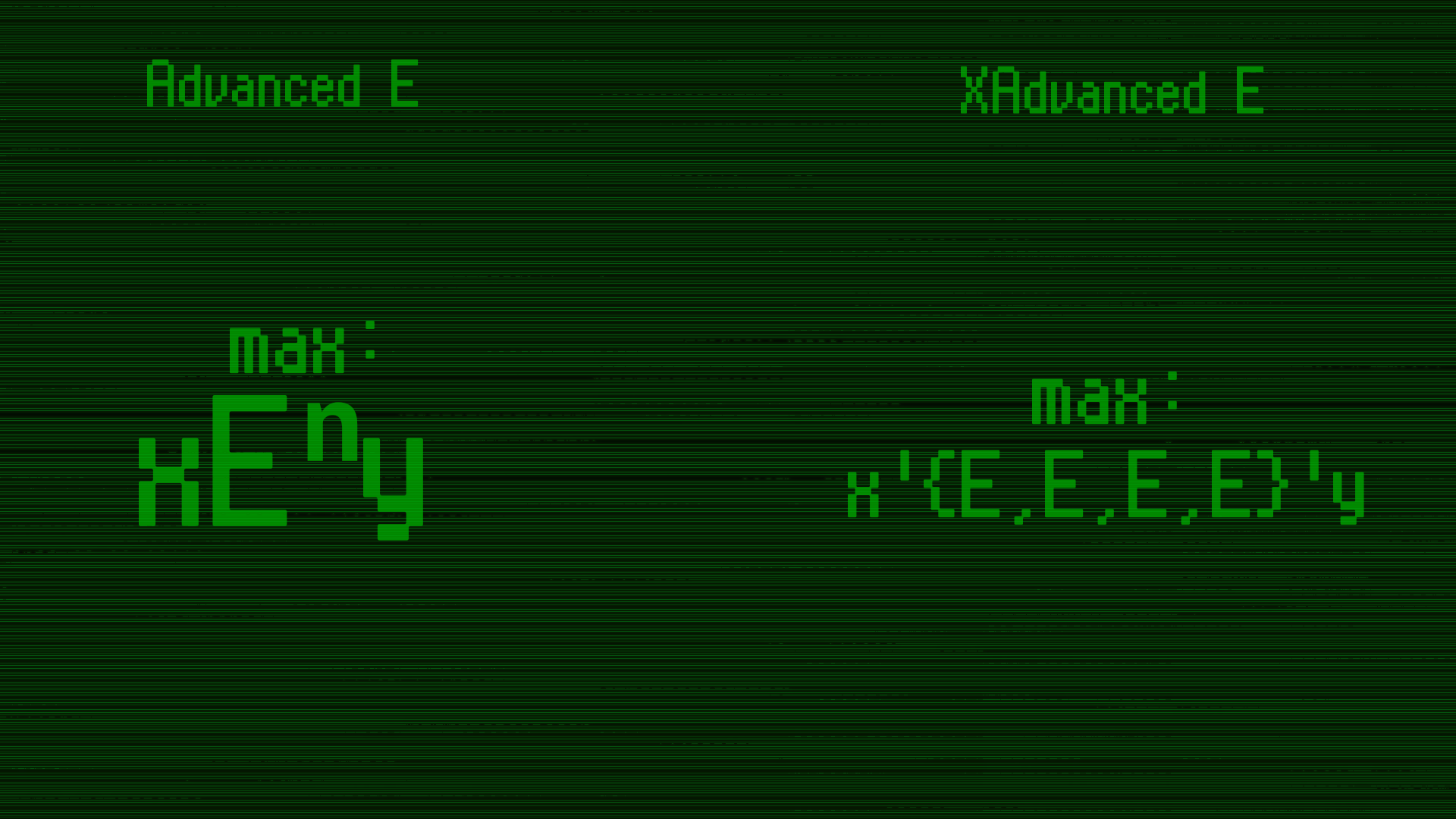
xEⁿy - Advanced
x'{E,E,E,E}'y - XAdvanced
rules
E = E¹ - arrow
(3EEE3 = 3E¹E¹E¹3 = 3^^^3)
Eⁿ = Eⁿ⁻¹Eⁿ⁻¹...Eⁿ⁻¹ (n times)
(E² = E¹E¹, Eⁿ = n! arrows)
XAdvanced:
E^E = E^E(n), E(n) = nEⁿn E^^E = E^^E(n), E^^^E = E(n),..., E{E}E = {E,E,E} = {E,E,E(n)}
{E,E,E,E} = {E,E,E(n),E(n)}, {E,E,E,E,E} is not exist.
limit of Advanced E = \(f_\omega(n)\)
limit of XAdvanced E = \(f_{\omega^\omega}(n)\)
  simple:
a{0}b = ab ≡ a×b
a{c}b = a^^...^^b (c times)
a{{...{1}...}}b = a{...{a{...{...{a}...}...}a}...}a (b times)
a{{...{c}...}}b = a{{...{c-1}...}}a{{...{c-1}...}}...{{...{c-1}...}}a (b times)

Multi‑dimensional:
a[c]b = a
a{{...{c}...}}[1]b = a{{...{a{{..{...a{{...{c}...}}a...}...}}a}...}}a (b times)
a{{...{c}...}}[n+1]b = a{{...{a{{...{...a{{...{c}...}}[n]a...}...}}[n]a}...}}[n]a (b times)

Nested:
a[[...[c]...]]b = a
a{{...{c}...}}[[...[1]...]]b =  a{{...{a{{..{...a{{...{c}...}}[...[a]...]a...}...}}[...[a]...]a}...}}[...[a]...]a (b times)
a{{...{c}...}}[[...[d]...]]b = a{{...{a{{...{...a{{...{c}...}}[[...[d-1]...]]a...}...}}[[...[d-1]...]]a}...}}[[...[d-1]...]]a (b times)

from these rules:
a{{1}}b = a{a{...{a}...}a}a (b times)
3{{1}}3 = 3{3{3}3}3
2{{{1}}}2 = 2{{2}}2 = 2{{1}}2{{1}}2 = 2{{1}}2{2}2 = 2{{1}}4 = 2{2{2{2}2}2}2 = 2{2{4}2}2 = 2{4}2 = 4
3{4}[1]2 = 3{3{4}3}3 = G_1
3{{3}}[1]3 = 3{{3{{3{{3}}3}}3}}3 = 3{{{1}}}3
3{3}[[1]]2 = 3{3{3}[3]3}[3]3

btw, {E,E,E,E,E} = {E,E,E(n),E(n),E(n)}
{a,b,c,d,e} = a{{...{c}...}}[[...[d]...]]b (d { }, e [ ])
If Eⁿ is found somewhere in { }, it is expanded from above to E¹E¹...E¹ and it is transformed into Eⁿ(m) where n is the number of E¹
btw, with this we can... 100'{E,E,E,E,E}'100 (big mountain)
Limit of XAdvanced E with {E,E,E,E,E} = \(f_{\varepsilon_0}(n)\)
what if... E Array??! Yez! in YAdvanced we can build {E,E,E,E,...,E} but. {E,E,E,...,E} -> {E,E(n),E(n),...,E(n)} and we can build E&E array. if you learn BEAF you know a&b = {b,b,b,...,b} (a times). E&E = E(n)&E. and we can E♦E! if you again learn BEAF you know a♦b = a&a&...&a (b times). in YA this E♦E = E♦E(n). we transform a huge array into an array with e elements through steps as in beaf
limt of YAdvanced E = \(f_{\Psi_0(\Omega_\omega)}(n)\)